Posts

Showing posts with the label Religion

Religion is a useful model

"All models are wrong Some of them are useful" ( aphorism  in  statistics ) Belief is in your deeds Let's observe first that we can never contain the whole complexity of the world in our brain. In most situations, we often use fuzzy heuristics to take decisions. For example, when a child makes a small mistake, you can never know if it's best for his future to punish him or to forgive him. The punishment might teach him to not do it again. The forgiveness might teach him to forgive and would protect his self esteem. We usually use our intuition and just hope it does not matter so much if we are wrong. We have stronger guidelines for more serious situations. "You shall not murder" is widely accepted as a strong rule in both religious and secular societies. However, there are exceptions to this rule, for example it's usually acceptable to kill someone to prevent more harm - like other killings. The only way to assess someone's adherence to a certain bel...
A secular God concept

All that is good In a first approximation, God is a catch-all concept about everything that is unexplained about the world and human life. Such God concept is consistent with most religious beliefs that I know. Most modern religions that contain some kind of "Evil" concept will associate God mainly with things that are good for humans. Here we will use this conceptual dichotomy between God and Evil. The mystery A God that contains all the unexplained features that are favorable to humans is inherently mysterious, even by the above definition. Why life exists rather than not? How that human life exists?

The God concept

Let's start by observing that most civilizations and individuals are developing a concept of God or Gods, even without outside preaching. Polytheistic religions Ancient Greeks and Romans had many Gods. Each God was powerful over a certain aspect of life. For example, Poseidon/Neptune governed the sea, storms, earthquakes. Each God embodied a certain aspect of live where human had little understanding about causation. Aphrodite/Venus governed the love, where humans still struggle to understand the causation.

Religions are (Software) Operating Systems

It is hard to live without a religion. Each religion comes with its set of APIs, for blessing and cursing, for forking a process child and for being sure a dying process doesn't become a zombie. Religions come with their set of protection mechanisms and their corresponding violation errors and punishments.

Morality and killing

Killing is morally wrong universally, for most people adhering to a moral system, right?  What about killing an aggressor that tries to kills hundreds of people in your community? Suddenly that killing to save the life of many innocents does not seem so repellent for most people, don't you agree? What if the killing of an aggressor is the only solution to save the life of a member of your family? Even many religious people would consider such defensive killing the right thing to do if there is no other solution.

Evil as striving for a local maximum

Let's observe first that we tend to attribute evil when there is a sufficient capacity of understanding the consequences of one's actions. A small child that produces a tragical accident is not considered evil usually, because there was no intent in doing that harm. We then observe that we judge evil in the contrast to another, better, possible action: "he could have decided to not kill him". We don't attribute evil when someone produces harm without having the possibility of doing something better. Moral judgement on evil is therefore a judgement of one's actions and decisions, in relation to some other actions or non-actions that would have resulted in a better world. That better is a highest "local maximum" that we can envision. The misdirected action is usually dictated by another, more narrow,  goal that is aiming at a smaller local maximum. For example, one can aim his narrow, selfish, good (local maximum) at the expense of others. T...

Hell

Being burned in hell for an eternity is not the worst that can happen. Even worse than this, for me, is to be entirely washed out from Existence. Burning in hell looks pretty painful indeed, but it still contains a glimpse of hope. After eons of suffering, a redemption is still possible, potentially. Suffering from burns is still a property of Life, something that suffers must exist and must somewhat live. There is still something that exists in the burning hell... Even worse than this, for me, is to disappear, gradually, then totally, from Existence. The eternal void is more frightening that any eternal pain. The eternal void does not leave any glimpse of hope for a better future. The eternal void is no future at all. * * *

On "Metaphysics of Quality" of Robert M. Pirsig

"It's more moral for a doctor to kill a germ than to allow the germ to kill his patient. The germ wants to live. The patient wants to live. But the patient has moral precedence because he's at a higher level of evolution" In "Lila, an Inquiry into Morals", Robert M. Pirsig brings intriguing reflections about the philosophy of moral using as pretext a river journey he had on a boat. Here I will bring my insights based on this book. Many of this reflections will be my own re-interpretations that were inspired by the book. Even my understanding on Pirsig's views might not fully correspond to the original author's intention.

We believe in a compressible Universe

"Believe" is often associated with religion. However, even for using the " scientific method ", we are forced to assume certain qualities of the Universe that we cannot prove nor fully verify. The most basic assumption is that there are common laws that are universal and they function the same across the whole Universe. This is a leap of faith that we have to take if we believe that the Universe can be understood at all by humans.

Two ways to pursue happiness

Image
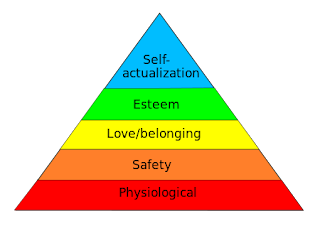
Intelligent people learn to adapt to environment,  unintelligent people adapt environment to them  (popular joke) 1. Change the outside Few people can be happy when basic needs are not met. When you are hungry or in pain it is unlikely that something else would make you happy. Even with the basic needs fulfilled, many people have higher order needs, like being appreciated, achieving their highest potential.

Morality derived from space colonization

I claim that most of the modern moral problems can be translated into "does this increases the likelihood of space colonization for humans?" This covers both traditional religious-based moral and more modern secular moral. You should take it with a grain of salt, of course ;), but let's see how it goes...

Is Your God so small?

Image
When I see the continuous fighting over Jerusalem... I would ask the people that are killing each other for a piece of "saint" land: "Is your God so small that He only lives on that little piece of land?"

What is the meaning of life?

If there is a meaning of life , then this meaning should only be achievable as long as life exists. You could still believe in a meaning "after life", however I personally find it unlikely. If the meaning would be only after life, the very existence of  this  life would be a bit... meaningless ;) I personally don't believe in a "life after death", at least not as a continuing existence of the person. I would be more willing to accept a kind of fuzzy "life after death" by informational replication and resulted impact on society (like in "live by your good deeds")

Is there a meaning of life?

You have an intuition on this, even if you cannot articulate it probably. Every major vector of our existence is derived somehow from this intuition: why we make children, why we try to preserve our existence, why we help others, why we don't kill each other. I would postulate that our everyday moral code can be derived from this intuition on "the meaning of life". The major religions captured it in slightly different ways; however there seems to be something more unifying behind various religious dogmas. I believe there is something very convergent in the intuition that we each have about the meaning of life. But wait; is there really a meaning of life? I would answer this by paraphrasing the Descartes's quote "I think, therefore I am". If there would not be any meaning of life, then there would be no meaning in everything we could do. The answer to this question would be meaningless too. If there is no meaning, it does not matter if we ans...