Posts

Showing posts with the label Money

Unequal inflation

It's common knowledge that if you print more money, you will produce inflation. However, things are more complex than that. You can have both inflation and deflation in the same time. More often, we have relatively low inflation on common products and high inflation on specific products - think real estate. Money velocity First, there is that "money velocity" that equals the equation Products * Price = Money * Velocity . The money velocity is intuitive, but cannot be practically measured except from this equation - thanks to my namesake friend for this idea.
On jobs and welfare

We often hear the expression "this creates jobs". But job creation cannot be good in itself. The state could create well payed jobs for everyone for doing nothing. Even with jobs, if nobody produces food, then people would starve. What is important is welfare creation - goods and services, that is often accompanied by occupied people that have jobs. Such welfare creation should equate to a better life for the ones who consume that created welfare. There are many nuances here. In these days, only a fraction of jobs is actually involved in creating goods and services that directly affect the quality of life. There is a high portion of jobs that are involved in organizing the welfare creation and redistribution. This includes management, state administration, banks, lawyers, police and more. Without a system to control the fair exchange of goods through money, people would tend to break contracts and steal from the welfare created by others. While such "administrative...

The Economy theory - goods and money

Welfare Welfare = produced  goods + redistribution curve At the basic level, welfare in society is just a matter of produced good (including services) and the redistribution curve. Money is not welfare in itself, as you cannot eat money. However, money is the system that controls the production and redistribution of goods. People with more money are entitled to consume more goods in this moment. But they can also chose to delay the consumption and have no impact in their welfare for the moment, then consume goods at a later time. Or money can lose value and can be never exchanged for the expected value. Money is motivation to produce goods Money also controls the motivation in the production of goods - like in working for salary or creating a company to get rich. Money permits to save the value of the goods that you produce now and later consume goods produces later - like when you retire. Money is used to redistribute goods to people that cannot produce goods (like unem...

Two ways to pursue happiness

Image
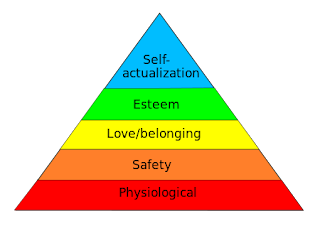
Intelligent people learn to adapt to environment,  unintelligent people adapt environment to them  (popular joke) 1. Change the outside Few people can be happy when basic needs are not met. When you are hungry or in pain it is unlikely that something else would make you happy. Even with the basic needs fulfilled, many people have higher order needs, like being appreciated, achieving their highest potential.

Debt gives value to money

What gives value to money? There was a time when money was pure gold. Later, money was a certificate that you own a quantity of gold in bank (banknotes). Now the money are just quality paper, without any deposit behind. How that it has any value? Some said that money is just a convention, and the fact that the state accepts that coin as the "legal tender" gives it value. However, we know many coins that lost theirs value despite the state effort to  sustain it. How that other coins survives? I claim that debt is the one that gives value to the today's (fiat) money.